280,000 additional homes
Econometric analysis shows 15% of all English completions over the decade were directly attributable to Help to Buy. Without it, those plots and the Section 106 affordable homes linked to them would never have broken ground.

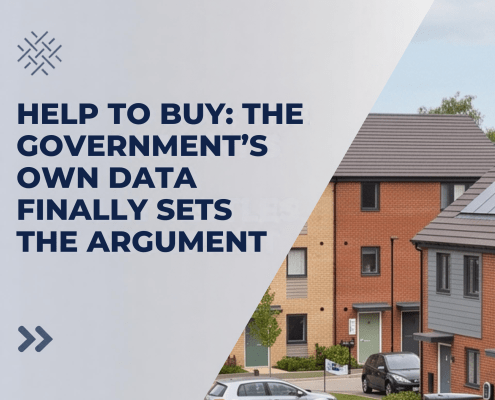
A 200-page MHCLG evaluation proves Help to Buy generated 280,000 additional homes, returned £1.75bn to the Exchequer and carried minimal price inflation. As ministers demand higher delivery numbers, the data makes buyer support impossible to ignore.
Critics spent years labelling Help to Buy an artificial prop that skewed house prices and handed unearned margins to developers. Anyone running a site, buying land or managing a regional housebuilder saw the reality: an equity loan that converted latent buyer demand into completions, unlocking schemes that otherwise sat on balance sheets.
The Ministry of Housing, Communities and Local Government has finally released the scheme’s independent evaluation. Led by Verian, the study confirms what housebuilders argued all along.
The policy worked, and it returned “very high” value for public money.
The review dispels several persistent myths about the 2013–2023 policy:
Housebuilding is governed by cash flow and sales absorption. Boards do not release capital for groundworks, roads and large parcels based on hope; they release it when sales rates prove the market can clear the stock.
Help to Buy underwrote that clearance rate. It allowed PLCs and regional SMEs to run multiple active outlets with the confidence that finished units would sell within acceptable holding periods.
Since the scheme ended, first-time buyers have run straight into punishing stress tests, steep interest rates and deposit requirements that take years to accumulate. Private alternatives like Deposit Unlock offer partial relief, but none possess the market presence or scale required to shift nationwide delivery figures.
Government wants 1.5m homes over the current parliament. Reforming the National Planning Policy Framework and enforcing mandatory local targets are sensible steps, but they only tackle supply constraints.
Local authorities can grant as many consents as they want. If buyers cannot access capital to purchase the finished product, developers cannot build out sites any faster than the open market will absorb them.
The evaluation proves that structured demand-side support creates tangible supply, protects construction employment and yields a direct financial return for the taxpayer.
If Whitehall is serious about hitting its targets, looking at buyer equity support is no longer optional. It is the obvious place to start.
Stay informed with our latest commentary on market trends, regulatory shifts and project delivery across the built environment.
 https://tglsearch.com/wp-content/uploads/2026/09/Newsletter-website-pic-2.png
1920
1920
dani
https://tglsearch.com/wp-content/uploads/2020/09/thomasgraylogo.svg
dani2026-09-16 15:25:272026-09-16 16:19:49Help to Buy: The Government’s Own Data Finally Settles the Argument
https://tglsearch.com/wp-content/uploads/2026/09/Newsletter-website-pic-2.png
1920
1920
dani
https://tglsearch.com/wp-content/uploads/2020/09/thomasgraylogo.svg
dani2026-09-16 15:25:272026-09-16 16:19:49Help to Buy: The Government’s Own Data Finally Settles the Argument https://tglsearch.com/wp-content/uploads/2026/09/AUGUST.jpg
1920
1920
Mia McKean
https://tglsearch.com/wp-content/uploads/2020/09/thomasgraylogo.svg
Mia McKean2026-09-01 15:14:012026-09-01 15:54:33Gray Matters: August Edition
https://tglsearch.com/wp-content/uploads/2026/09/AUGUST.jpg
1920
1920
Mia McKean
https://tglsearch.com/wp-content/uploads/2020/09/thomasgraylogo.svg
Mia McKean2026-09-01 15:14:012026-09-01 15:54:33Gray Matters: August Edition https://tglsearch.com/wp-content/uploads/2026/08/HBF-60BN-1.png
1920
1920
Mia McKean
https://tglsearch.com/wp-content/uploads/2020/09/thomasgraylogo.svg
Mia McKean2026-08-25 15:55:222026-08-28 10:43:15Government Announces First £9.58bn of Affordable Homes Funding
https://tglsearch.com/wp-content/uploads/2026/08/HBF-60BN-1.png
1920
1920
Mia McKean
https://tglsearch.com/wp-content/uploads/2020/09/thomasgraylogo.svg
Mia McKean2026-08-25 15:55:222026-08-28 10:43:15Government Announces First £9.58bn of Affordable Homes Funding
Thomas Gray Limited (Registered in England & Wales No. 07839720) of Crest House,
53 Station Road, Egham, Surrey, TW20 9LG

© 2024 – All Rights Are Reserved

 Sales Manager